How to Read a Tire Size: 235/65R17 Explained
In this guide
A 235/65R17 tire is 235 mm wide, has a sidewall 65 percent as tall as it is wide, is of radial construction and fits a 17-inch wheel. Put together, those numbers describe a tire that is nominally 29.0 in tall and 9.3 in wide, with a 6.0 in sidewall. The size code is a formula, and once you can read it you can work out the height of any tire from the digits alone.
This guide uses 235/65R17 throughout because it is one of the three most widely fitted sizes in our data: twelve current models list it. The geometry comes from the same functions that build this site’s tire size pages; the meaning of each part of the code follows Yokohama Tire’s guide to reading a sidewall.
The four parts of the code
| Part | In 235/65R17 | What it tells you |
|---|---|---|
| Section width | 235 | Width of the tire in millimetres: 9.3 in |
| Aspect ratio | 65 | Sidewall height as a percentage of the width: 6.0 in |
| Construction | R | Radial |
| Rim diameter | 17 | Diameter of the wheel it fits, in inches |
Notice that the code mixes units. Width is metric, the wheel is in inches and the sidewall is not a measurement at all but a percentage. That is why two tires with the same middle number can have very different sidewalls.
Section width: 235
Yokohama describes the three-digit number as the tire’s section width in millimetres and adds that the actual tire may not match it perfectly, but is close. Divide by 25.4 for inches: 235 / 25.4 = 9.3 in.
Aspect ratio: 65
The two digits after the slash are the section height divided by the section width, as a percentage. In Yokohama’s words, the higher the aspect ratio, the taller the sidewall. Here the sidewall is 65 percent of 235 mm.
Construction: R
R identifies a radial tire. Yokohama notes that in rare cases a D marks bias-ply construction, where the body plies crisscross on a diagonal. Every factory size in our data is a radial.
Rim diameter: 17
The last two digits are the diameter, in inches, of the wheel the tire is made to fit. A 17 in tire goes only on a 17 in wheel.
The maths: from code to height
The site’s tire pages use two lines of arithmetic: sidewall = width x aspect ratio, and diameter = rim + 2 x sidewall. For 235/65R17:
- Sidewall: 235 mm x 0.65 = 152.75 mm. Divided by 25.4, that is 6.01 in.
- Diameter: 17 in + 6.01 in + 6.01 in = 29.03 in, shown as 29.0 in.
- Circumference: 29.03 in x 3.1416 = 91.2 in. That is how far the vehicle moves in one turn of the wheel.
- Revolutions per mile: a mile is 63,360 in, and 63,360 / 91.2 = about 695.
Those are the figures on the 235/65R17 page: 29.0 in tall, 9.3 in wide, a 6.0 in sidewall, 91.2 in around and about 695 revolutions per mile. They are nominal. They come from the designation, not from a ruler, and a mounted, inflated tire of a given brand can differ slightly.
Change one number at a time
Each part of the code moves the height in a predictable way. All figures are from the site’s geometry function.
| Size | What changed | Width | Sidewall | Diameter |
|---|---|---|---|---|
| 225/65R17 | 10 mm narrower | 8.9 in | 5.8 in | 28.5 in |
| 235/65R17 | the example | 9.3 in | 6.0 in | 29.0 in |
| 245/65R17 | 10 mm wider | 9.6 in | 6.3 in | 29.5 in |
| 235/60R17 | aspect ratio down 5 | 9.3 in | 5.6 in | 28.1 in |
| 235/70R17 | aspect ratio up 5 | 9.3 in | 6.5 in | 30.0 in |
Two things stand out:
- A wider tire is also a taller tire when the aspect ratio stays the same, because the sidewall is a percentage of the width. Going from 235 to 245 adds 0.4 in of width and about 0.5 in of height.
- The aspect ratio moves height faster. Five points on a 235 mm tire is 11.75 mm per sidewall, and there are two sidewalls in the diameter, so the tire grows by about 0.9 in.
245/65R17 and 235/70R17 are shown for the arithmetic only: no model in our data lists either as a factory size, so they have no page here.
Same height on different wheels
Makers use the formula in reverse. When a higher trim gets a bigger wheel, the aspect ratio drops so that the overall diameter barely moves. Honda’s 2027 CR-V specifications list three sizes, and the Honda CR-V page shows all of them:
| Size | Wheel | Sidewall | Diameter | Revs per mile |
|---|---|---|---|---|
| 235/65R17 | 17 in | 6.0 in | 29.0 in | 695 |
| 235/60R18 | 18 in | 5.6 in | 29.1 in | 693 |
| 235/55R19 | 19 in | 5.1 in | 29.2 in | 691 |
| 255/45R20 | 20 in | 4.5 in | 29.0 in | 695 |
The first three are the CR-V’s factory sizes: two more inches of wheel, 0.9 in less sidewall, and a diameter that changes by 0.5 percent. The 2027 Kia Sportage, 2027 Nissan Rogue and 2026 Hyundai Tucson list the same three. The fourth row is not a CR-V size; it is the 20 in size that seven other models list, including the 2027 Kia Sorento, and it lands on 29.0 in again with a wider 255 mm section.
This is the idea to hold on to. The number people compare when they talk about tire size is the overall diameter, and it appears nowhere in the code. You have to calculate it, or use the tire size calculator, which runs the same arithmetic on any two sizes.
Letters before and after the numbers
The sizes in our data are stored as plain numbers, such as 235/65R17. On a sidewall you will usually see more around them. Yokohama’s guide explains the common additions:
- P in front (P235/65R17): a passenger tire designed to the Tire and Rim Association standard, known as P-metric.
- No letter in front: a passenger tire designed to the European standard, known as Euro-metric or hard-metric. Yokohama says these are dimensionally equivalent to P-metric sizes but typically differ subtly in load-carrying capability.
- LT in front (LT215/75R15 is Yokohama’s example): a light-truck tire for pickups, which carry and tow more than passenger cars.
- C at the end: a Euro-metric commercial tire for vans and delivery trucks that carry heavy loads.
- Flotation sizes such as 35x12.50R17LT: an older convention that states the diameter and width in inches directly.
After the rim diameter comes the service description: two or three digits and a letter. Yokohama describes the digits as the load index, which defines the tire’s maximum loading capacity, and the letter as the speed rating. This site does not hold either for any vehicle, so we do not quote them. The U.S. Tire Manufacturers Association’s replacement guidance says your vehicle’s tire specifications are usually on a label inside the driver’s door, in the glove box or in the fuel door, and in the owner’s manual, and that replacement tires should match the size, load index and speed rating the vehicle or tire manufacturer recommends. Yokohama adds that the recommended inflation pressure is on the placard in the driver’s door panel; it is not part of the size.
Because the geometry depends only on the three numbers, a P235/65R17 and a plain 235/65R17 work out to the same nominal 29.0 in. What differs is what they are built to carry.
Which vehicles use 235/65R17
Twelve current models in our data list 235/65R17 for at least one trim, taken from each maker’s published specification for the model year shown.
| Vehicle | Model year | Class |
|---|---|---|
| Toyota RAV4 | 2027 | SUV |
| Honda CR-V | 2027 | SUV |
| Nissan Rogue | 2027 | SUV |
| Kia Sportage | 2027 | SUV |
| Kia Sorento | 2027 | SUV |
| Hyundai Tucson | 2026 | SUV |
| Chevrolet Equinox | 2025 | SUV |
| GMC Terrain | 2025 | SUV |
| Toyota Sienna | 2026 | Minivan |
| Chrysler Pacifica | 2027 | Minivan |
| Kia Carnival | 2027 | Minivan |
| Ford Maverick | 2026 | Pickup |
It is one of only three sizes in the data that turn up on three classes of vehicle. Six of the twelve are among the nine models in compact SUV sizes compared. Larger vehicles step up from there: of the models in three-row SUV sizes compared for which we hold tire sizes, the Telluride, Palisade, Pilot, Highlander, Pathfinder, Ascent and Atlas all start on 18 in wheels, and the trucks in full-size pickup lengths compared run to much taller tires, with the Ford F-150 listing sizes from 30.5 to 34.4 in.
How far the numbers range
Across the 112 factory sizes in our data, listed for 101 current models:
- Width runs from 185 to 325 mm (7.3 to 12.8 in).
- Aspect ratio runs from 30 to 75.
- Wheel diameter runs from 15 to 24 in, with 18 in the most common.
- Overall diameter runs from 24.5 in for the 185/65R15 on the Hyundai Venue to 34.4 in for the 315/70R17 that the F-150, Jeep Wrangler and Jeep Gladiator list.
A low aspect ratio does not mean a small tire. The 285/40R24 listed for the Ford Expedition has a 40-series sidewall of 4.5 in, yet stands 33.0 in tall because of its 24 in wheel.
Where to find your own size
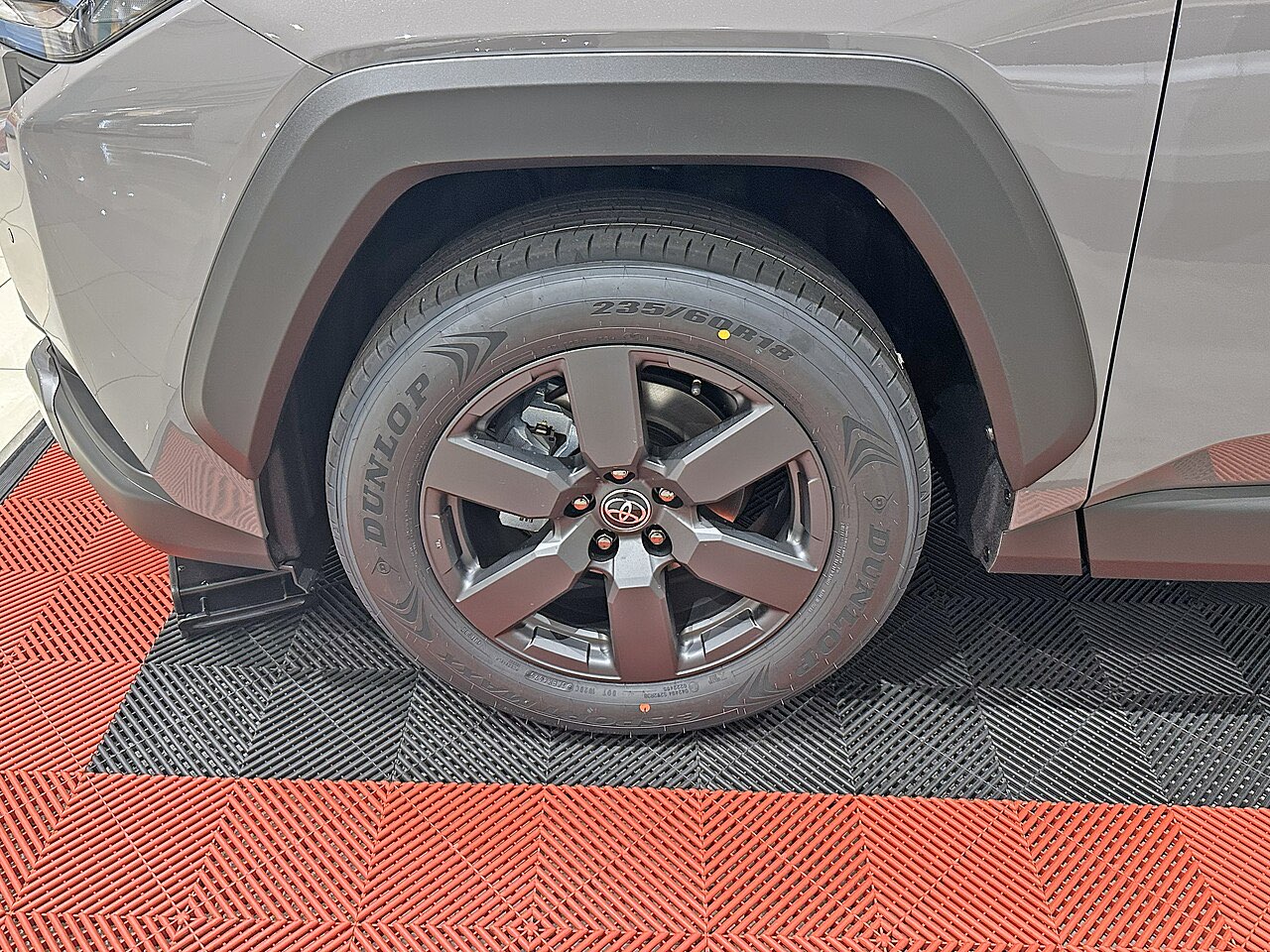
- The tire sidewall. The size is molded into the rubber, as in the photo at the top of this page, where a RAV4’s tire reads 235/60R18.
- The vehicle’s tire label. This is the size the maker specified, which matters if a previous owner changed the tires.
- This site. The tires by vehicle list gives the factory sizes each maker publishes, and every size links to its own page with the vehicles that share it.
If you are measuring the whole vehicle rather than its tires, for instance for a cover, see how to measure your car for a cover.
Limits of these figures
- Nominal, not measured. Diameter, sidewall and revolutions per mile are calculated from the designation. A real tire’s measured diameter varies a little by brand and model.
- Sizes vary by trim and package. We list the sizes in each maker’s specification for the model year shown. Your trim may have only one of them.
- Not every model is covered. 101 of the models on this site have tire sizes from a maker specification; the rest are left out, not estimated.
- No load, speed or pressure data. Read those from your vehicle’s label and owner’s manual, and ask a tire professional before fitting a size the maker did not specify.
Frequently asked questions
What does 235/65R17 mean?
235 is the section width in millimetres (9.3 in), 65 is the aspect ratio, meaning the sidewall is 65 percent as tall as the tire is wide (6.0 in), R means radial construction and 17 is the wheel diameter in inches. Worked out from those numbers, the tire is nominally 29.0 in tall.
How tall is a 235/65R17 tire?
Nominally 29.0 in. The sidewall is 235 mm x 0.65 = 152.75 mm, or 6.01 in, and the diameter is the 17 in wheel plus two sidewalls: 17 + 6.01 + 6.01 = 29.03 in. That gives a circumference of 91.2 in and about 695 revolutions per mile. A real tire's measured diameter varies a little by brand and model.
What does the R in a tire size stand for?
Radial, the way the tire's internal plies are laid. Yokohama's sidewall guide says an R after the aspect ratio identifies a radial tire and that, in rare cases, a D identifies bias-ply construction with plies that crisscross diagonally. R does not stand for rim, although the number after it is the rim diameter.
Is a higher aspect ratio a taller tire?
Yes, for the same width and wheel. A 235/60R17 is 28.1 in tall, a 235/65R17 is 29.0 in and a 235/70R17 is 30.0 in: each 5-point step in aspect ratio adds about 0.9 in of diameter at this width, because it adds 11.75 mm to each of the two sidewalls.
Where do I find the load index and speed rating?
They are the number and letter printed after the size on the tire's sidewall, called the service description. The U.S. Tire Manufacturers Association says a vehicle's tire specifications are usually on a label inside the driver's door, in the glove box or in the fuel door, and in the owner's manual. This site does not hold load index or speed rating data.
Which vehicles use 235/65R17 tires?
Twelve current models in our data list 235/65R17 as a factory size, among them the 2027 Toyota RAV4, 2027 Honda CR-V, 2027 Nissan Rogue, 2027 Kia Sportage, 2026 Hyundai Tucson, 2026 Toyota Sienna and 2026 Ford Maverick. Sizes vary by trim, so check the label on your own vehicle.
Keep planning
- Compact SUV Sizes Compared: Length, Width and Height
Nine compact SUVs side by side: maker-published length, width, height, cargo volume and towing, plus how each fits a one-car and two-car garage.
Updated Nov 2026 - Full-Size Pickup Lengths Compared by Cab and Bed
F-150, Sierra 1500, Ram 1500 and Tundra lengths by cab and bed from maker specs, with Silverado lab data, bed dimensions and the garage depth each needs.
Updated Nov 2026 - How Deep Does a Garage Need to Be for a Full-Size Truck?
A crew-cab half-ton is 232 to 246 in long, so it needs a 24 ft deep garage to leave a 36 in walkway. Depth by truck, cab and bed, from sourced lengths.
Updated Nov 2026